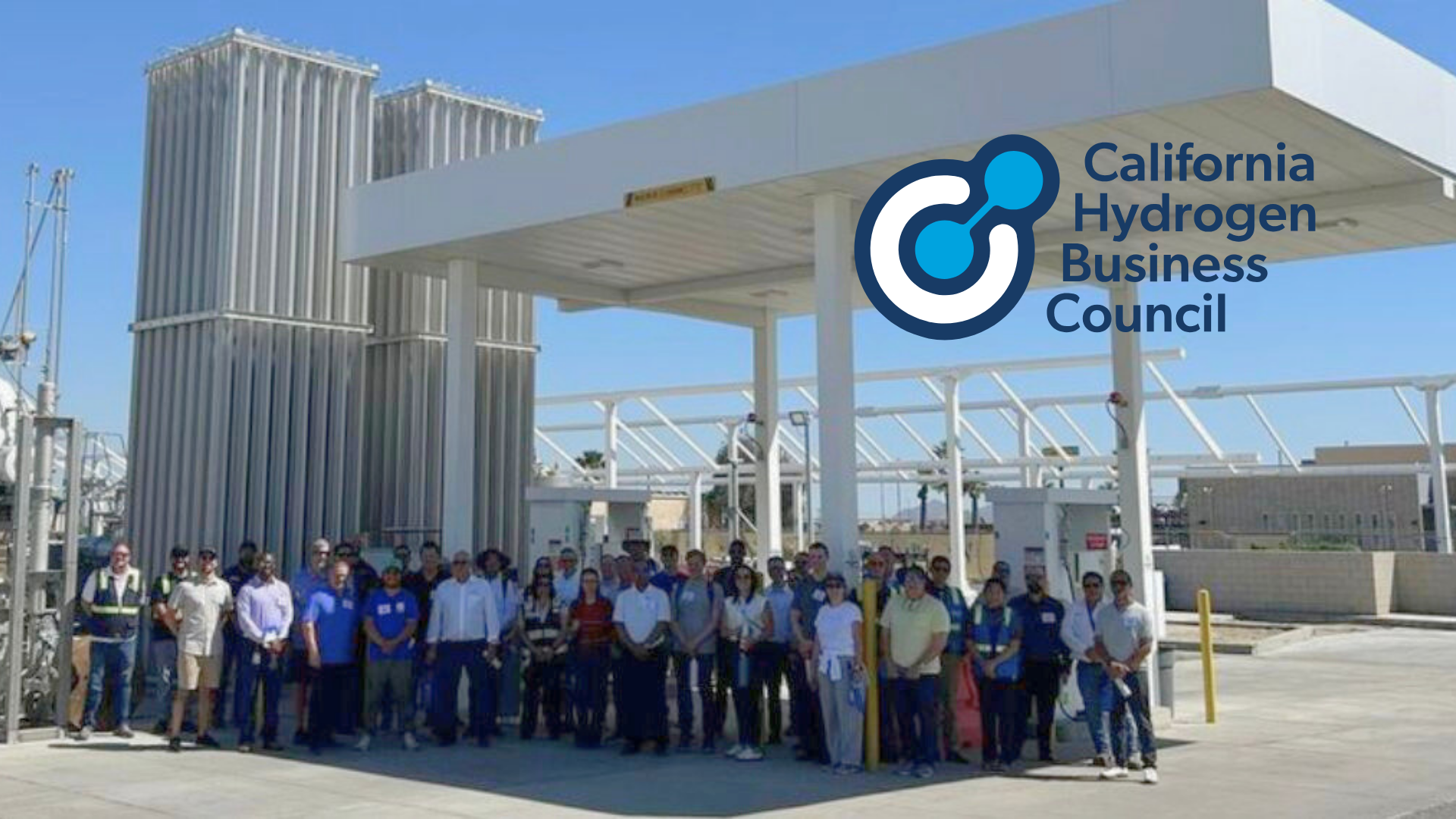
At the California Hydrogen Business Council's (CHBC) fuel cell bus workshop at SunLine Transit Agency in Palm Desert, CA from April 7-8, the message was clear: despite challenges in infrastructure and policy uncertainty, fuel cell buses are proving their value where it matters most – in real-world operations.
The event brought together representatives from 60 industry players including transit agencies such as Foothill Transit, Riverside Transit Agency, and Santa Cruz Metro - as well as policymakers and technology providers to bridge the gap between pilot projects and full-scale, commercial fleet deployment.
Delivering a 360-degree view of the hydrogen transit ecosystem, the workshop involved technical deep-dives, expert panels and roundtables, and dynamic industry discussions – following a kick-off that provided a high-level industry state-of-the-nation that highlighted the critical role of fuel cell buses in high-utilization fleets.
.gif?width=1920&height=1080&name=CHBC_gif%20(1).gif)
A team of Ballard experts presented the latest advancements in fuel cell technology focused on increased uptime, durability and simplified maintenance; while other CHBC members demonstrated new modular hydrogen refueling stations (HRS) with the capacity to scale as fleets develop and expand.
A keynote session at the event addressed fuel cell bus total cost of ownership (TCO), where attendees analyzed data from real-world deployments showing how rising carbon credits and the decreasing cost of green hydrogen are contributing to a narrowing gap with diesel. Transit managers also participated in a fleet transition planning session which used Ballard's proprietary modeling tools to simulate the deployment large fuel cell bus fleets. 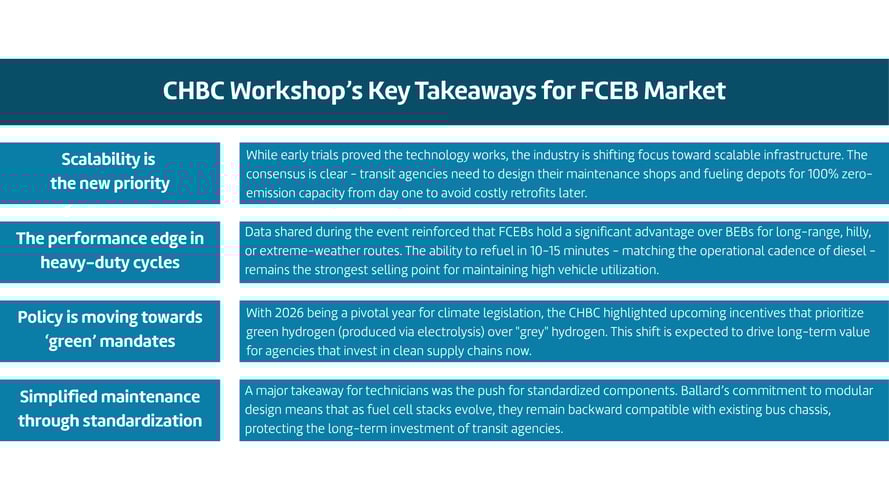 Deployment challenges
Among the most critical bottlenecks explored during the event, participants emphasized the complexity and time-consuming nature of HRS deployment as a major issue – with coordination between bus delivery timelines and HRS commissioning flagged by several agencies as a significant operational risk.
Affordability remains a commercial challenge for fuel cell buses – with unit costs combined with inflated hydrogen fuel prices making procurement complex when comparing with alternative technologies such a battery-electric.
Policy uncertainty was also high on the agenda as the federal administration's halted zero-emission bus (ZEB)-related FTA grant awards, and the cancellation or “pause” of the ARCHES hydrogen hub has a direct impact on Californian operators. However, the state's Innovative Clean Transit (ICT) regulation continues to drive ZEB mandates, and agencies such as the California Air Resources Board (CARB) and California Energy Commission (CEC) are maintaining and reinforcing funding programs.
Reasons to be positive
Underlining California's commitment to fuel cell technology for transit, CARB confirmed 437 hydrogen-powered buses in service or on order at end of 2024, with 45 agencies actively considering the transition to fuel cells for their fleets.
Hydrogen infrastructure is also a maturing ecosystem, with suppliers such as Bosch, GenH2, and Hatch in the process of building comprehensive refueling solutions for transit, with liquid hydrogen emerging as a preferred option to cater for larger depot sizes.
And despite ongoing headwinds, the ICT regulation provides a structural demand driver that is not dependent on federal support, and as such California's fuel cell bus market continues to develop - illustrated by the encouraging number of units already on the road or set to be by the end of the year.
Across the two days the CHBC workshop underlined the importance of industry and public sector collaboration when it comes to achieving wide-scale adoption of fuel cell buses. By integrating proven fuel cell technology with strategic infrastructure planning, the transit industry continues its path toward zero-emissions.
The event concluded by presenting a clear roadmap for transit agencies to achieve not just zero emissions, but a sustainable and profitable bottom line heading towards 2030.