#PoweredByBallard
CrossWind project: Base Load Power Hub arrives in Netherlands
The CrossWind offshore wind project has reached another milestone as the Base Load Power Hub arrives in the Netherlands


Ballard powers the Phynix Baseload Power Hub - which is an integral part of the CrossWind HKN program


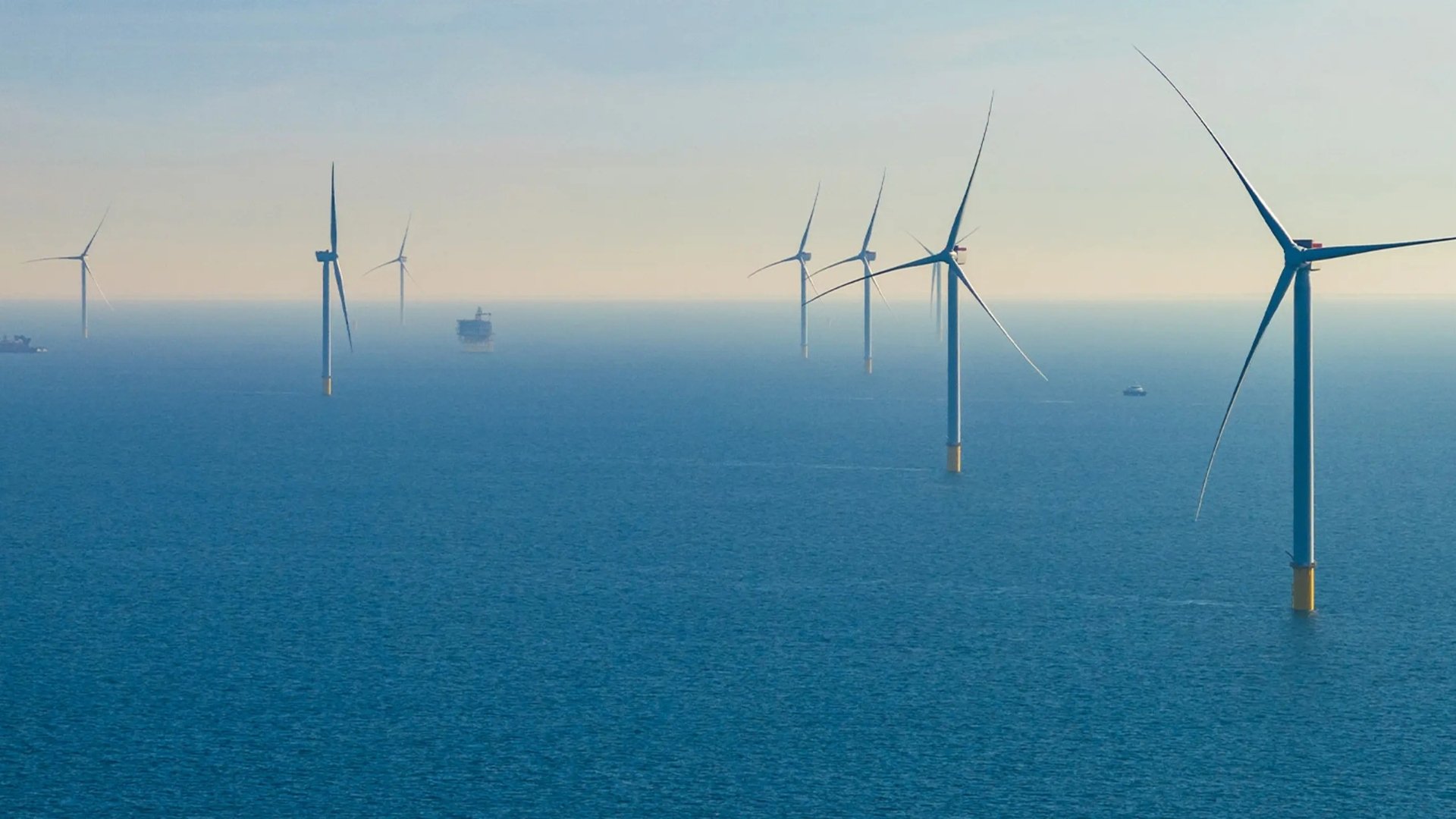
The CrossWind Hollandse Kust Noord (HKN) project represents a fundamental shift in offshore energy, moving beyond electricity generation to create a self-sustaining, "super-hybrid" power plant. At the initiative's core is the Ballard-powered Phynix Baseload Power Hub (BLPH), which is the first offshore fuel cell-powered platform designed to smooth wind intermittency by producing, storing, and re-converting green hydrogen.
The CrossWind HKN program integrates wind, floating solar, and a sophisticated hydrogen-to-power loop – aiming to solve the critical challenge of intermittency, providing a stable, baseload supply of renewable energy to the grid regardless of weather conditions.
This deployment serves as a vital real-world testbed for stationary zero-emission applications; proving that hydrogen fuel cell technology can successfully scale to provide reliable, high-output backup power in the most demanding environments, effectively turning unpredictable natural resources into a consistent and resilient energy commodity.
As a landmark initiative, CrossWind HKN was originally an offshoot from the Dutch national offshore wind roadmap, designated by the government to significantly enhance gigawatt production from offshore wind.
Located at the Port of Eemshaven near Alkmaar in the Netherlands, the project is a joint venture between multinational energy companies Shell and Eneco – established with a mandate to pioneer, requiring “innovative elements” to demonstrate offshore wind’s potential and power to provide a constant power supply to the grid.
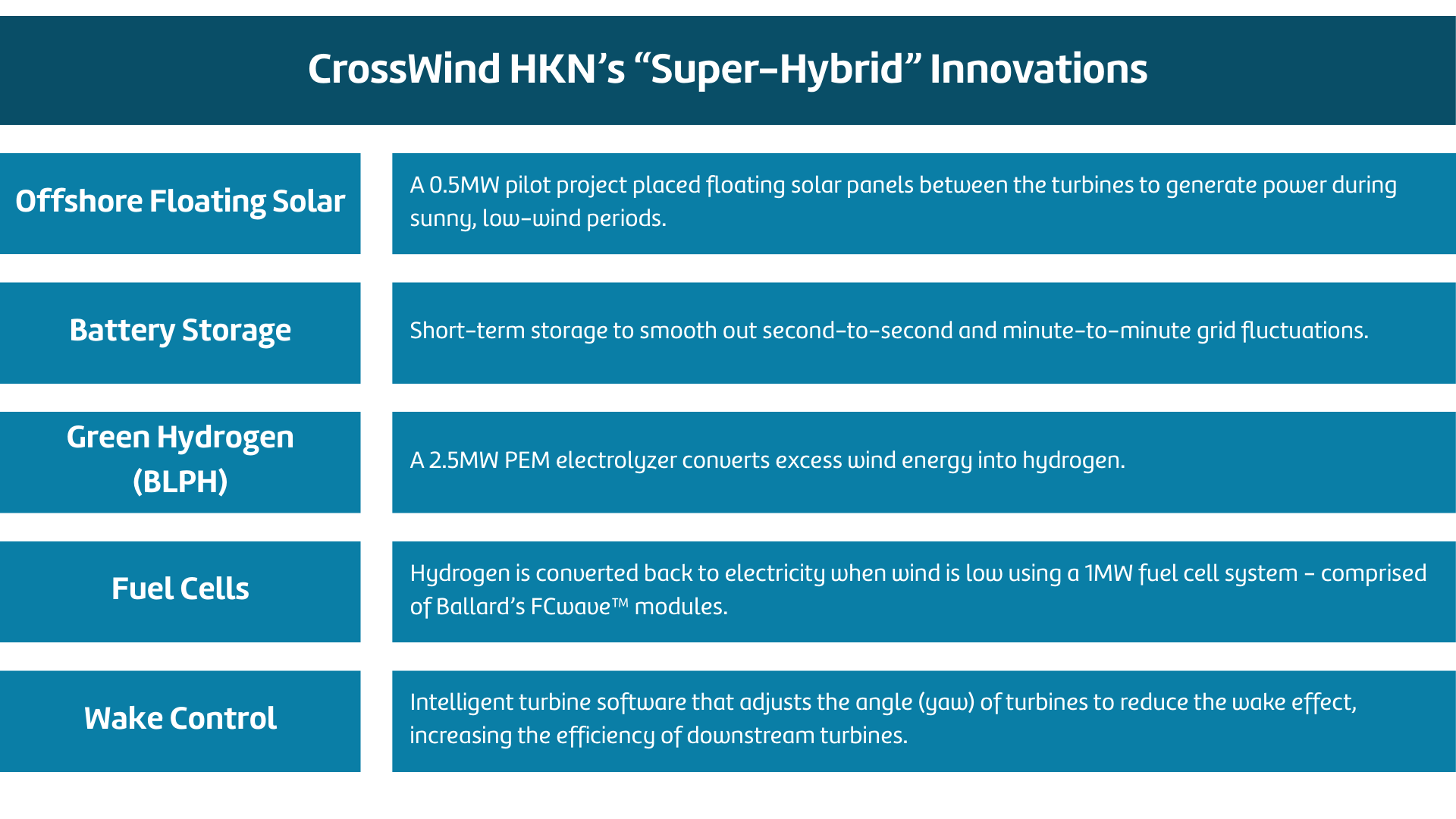 The initiative’s development phase focused on the rapid deployment of 69 Siemens Gamesa 11MW turbines, while simultaneously engineering the Phynix hybrid BLPH. Offshore construction began in October 2022 and was officially completed by December the following year, with the wind farm reaching full operational status with a capacity of 759MW – enough to power approximately 1 million homes across the Netherlands.
The 1MW fuel cell system provided by Ballard for CrossWind HKN is centered on the company’s tested, durable, and efficient FCwave™ platform. This technology was specifically chosen to solve the "round-trip" challenge: converting stored green hydrogen back into electricity to maintain a stable grid when the wind stops blowing.
Phynix's system is a containerized solution designed for the challenging conditions posed by the harsh offshore environment of the North Sea. Configured for peak shaving – absorbing excess wind energy when generation exceeds demand and releasing stored energy during low-wind periods – the BLPH demonstrates how hydrogen can balance renewable output and enhance grid stability.
Ballard’s overall system comprises six 200kW FCwave™ modules working in parallel. This modularity allows for "hot-swapping" or maintenance on one unit without having to shut down the entire 1MW plant. Operating with a peak fuel efficiency of approximately 53.5%, when the fuel cell units combine with the platform’s electrolyzer, a high-efficiency energy buffer is created for the wind farm.
The modules are housed in IP44-rated enclosures, specifically engineered to handle high humidity and salt spray. They utilize a liquid-cooling system that can operate effectively in temperatures ranging from 0°C to 45°C.
This project is a primary "proof point" for the industry. By integrating Ballard’s proton-exchange membrane (PEM) technology, CrossWind HKN has demonstrated that offshore wind farms can move away from being "intermittent" energy sources and operate confidently - the same as traditional, reliable power plants.
As of early 2026, the project has transitioned from a purely commercial wind farm to a live research and development hub for the energy transition. The site is now fully operational and is meeting agreed power generation target of approximately 3.3TWh per year.
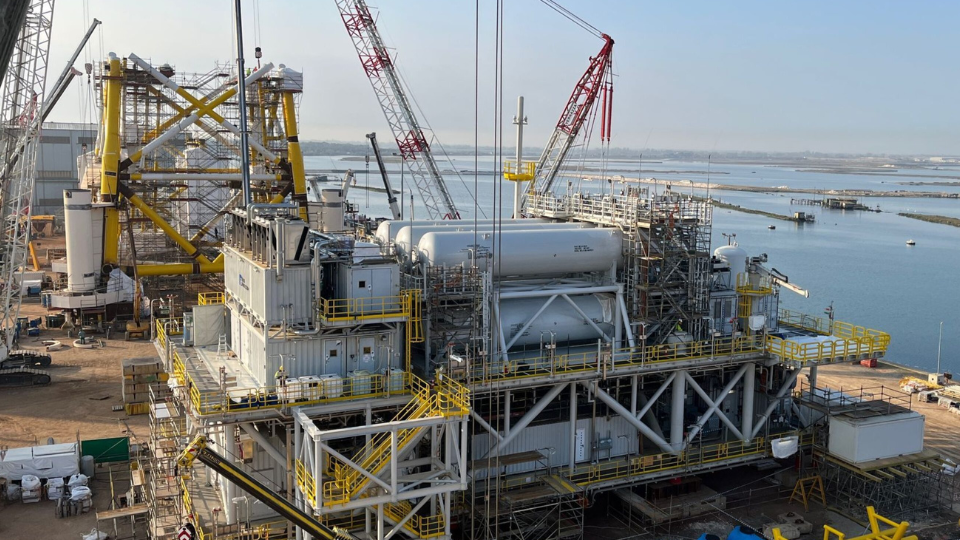
Having been handed over to Delft Offshore Turbine (DOT) and renamed Phynix in October 2025, the BLPH is now fully integrated at the Eemshaven base and is focused on research into offshore hydrogen production and storage in collaboration with academic and industry partners from the Groningen Hydrogen Valley project to optimize offshore hydrogen production.
As part of this overall development, Ballard’s system is now moving into a long-term research phase, concentrated on optimizing the stack life of the fuel cells when subjected to the frequent start-stop cycles required by wind power fluctuations.
The CrossWind offshore wind project has reached another milestone as the Base Load Power Hub arrives in the Netherlands
HDF Energy is installing a fuel cell system in French Guiana, designed to deliver stable, round-the-clock, zero-emission electricity.
Ballard Power Systems and Element 1 are collaborating to develop hydrogen power initiatives and bring sustainable energy solutions to wider global...