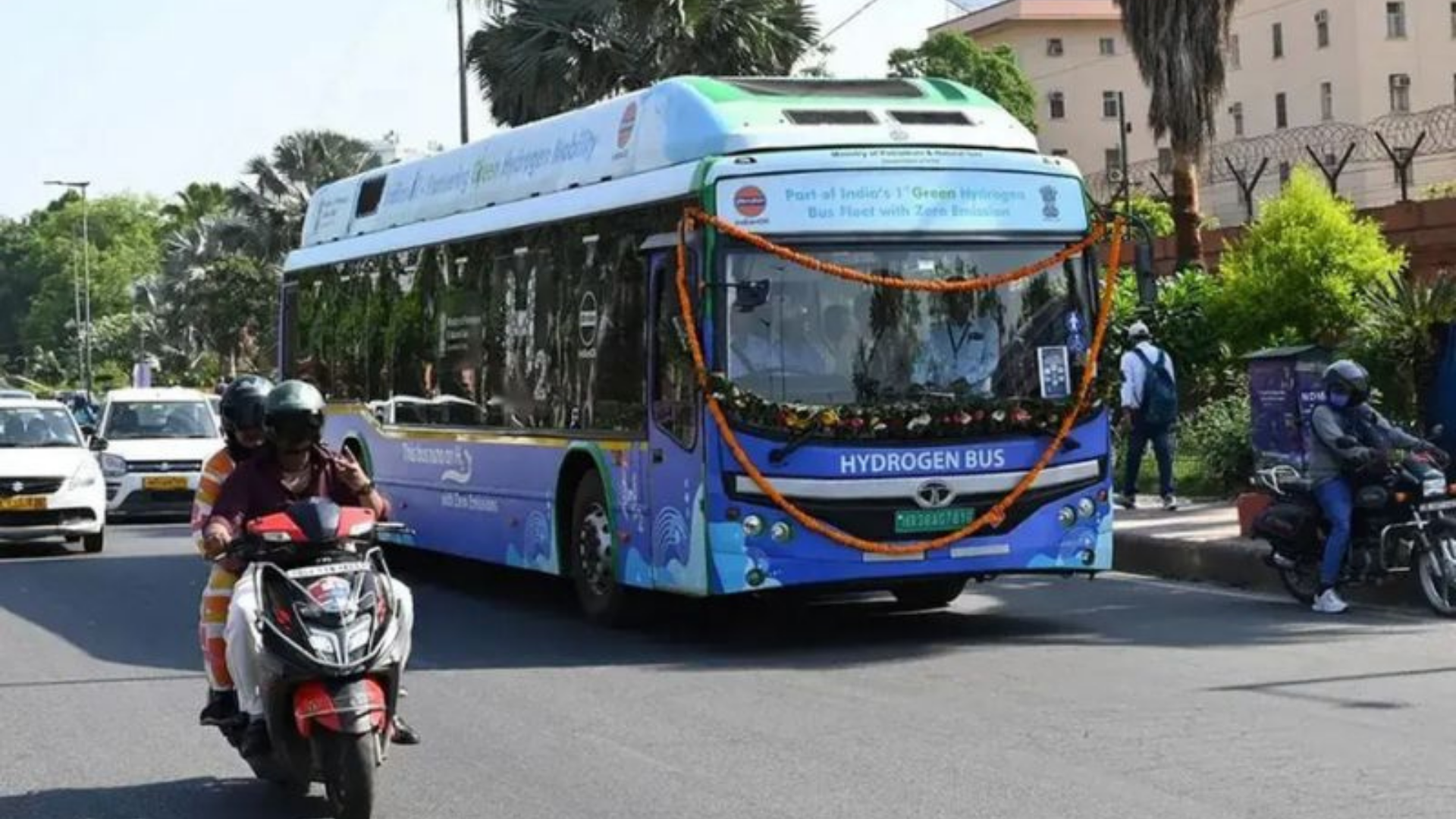
Driving India’s zero-emission transportation journey forward, two Tata Motors fuel cell buses, powered by Ballard, have entered regular service in Delhi. Representing a significant milestone for hydrogen mobility, the buses are among the first fuel cell-powered public transport vehicles to be deployed in the nation’s capital.
Initially two zero-emission vehicles are now in service but the project’s importance extends far beyond fleet size. Operated by the Delhi Metro Rail Corporation (DMRC) and supplied by Tata Motors as part of a broader hydrogen mobility enterprise with Indian Oil Corporation (IOCL), the initiative provides India with a real-world demonstration of hydrogen fuel cell technology, now live in one of the world's busiest and most challenging urban transport environments. It also signals growing momentum behind India's ambition to develop a domestic hydrogen economy under its National Green Hydrogen Mission.
The Tata buses utilize Ballard’s FCmove®-HD 70kW fuel cell engine - an advanced module for medium- to heavy-duty decarbonized vehicles which offers a compact and durable solution that is easy to install in a rooftop configuration. Leveraging Ballard's proven proton-exchange membrane (PEM) technology, the solution enhances power, efficiency, and delivers an operational range up to 400km, while improving reliability and system integration flexibility.
The buses originate from Tata Motors' pioneering 15-bus hydrogen fuel cell program awarded by IOCL in 2021, all of which are supported by Ballard fuel cell technology.
 [Image: ANI]
For India, hydrogen presents a compelling opportunity in sectors where battery-electric (BEB) solutions face limitations. Long-distance buses, heavy trucks, mining equipment and other commercial vehicles require high utilisation rates, rapid refuelling and extended range. Hydrogen fuel cells can meet these requirements while delivering zero-emission operation.
The Delhi deployment serves as an important proving ground. Beyond demonstrating vehicle performance, the project will generate valuable data on hydrogen consumption, operational reliability, maintenance requirements and refuelling logistics. Such information is critical for policymakers, transport operators and manufacturers considering future investments in hydrogen infrastructure and vehicle fleets.
As countries around the world explore multiple pathways to decarbonize transport, India's approach increasingly recognizes that no single technology will solve every challenge. BEBs are expected to dominate many urban applications, while hydrogen emerges as a complementary solution for heavier and longer-range transport sectors.
The arrival of Tata Motors' Ballard-powered fuel cell buses in Delhi represents an early insight into how hydrogen can become part of India's future mobility landscape, helping the country reduce emissions, improve energy security, and build a domestic clean-energy industry capable of supporting sustainable economic growth.